Sunday, May 18, 2014

Growing Up in the Sixties, by Aaron Lazar

http://www.amazon.com/Spirit-Me-Away-LeGarde-Mysteries-ebook/dp/B00K7RA8QW/ref=sr_1_2?s=digital-text&ie=UTF8&qid=1400147007&sr=1-2&keywords=spirit+me+away
copyright 2014, AP Lazar

I was sixteen years old in 1969. Man, was that a time to be alive, especially for a young man with access to Boston and all the happenings of that era.

There was the Psychedelic Supermarket, where I saw Traffic (Stevie Winwood, Chris Wood on flute), The Boston Tea Party (where I saw Led Zeppelin in their first ever USA appearance, Jeff Beck, Rod Stewart, and more), and the Cambridge Commons, where the Love-Ins happened every Sunday afternoon. We enjoyed so many bands for free in that sunny park, from Alice Cooper to Chicago to the many “Boss-Town Bands” that cropped up in that era like Ultimate Spinach, Eden’s Children, and so many more. I listened to Tom Rush play and sing in a tiny hall at Northeastern University, and of course we always bought tickets when the Stones, Jimi Hendrix, BB King, Johnny Winters, and other bands came to town.

Yes, it was a time of heady music, flamboyant behavior, and plenty of love.

Granted, at the time, I was just madly in love with my soul mate (now my wife of 33 years), who also loved the music, and like me, didn’t love the drugs. We stayed healthy and sober while getting “high” off the music. And we both liked it that way.

When I started writing the LeGarde Mystery series in 1997, I pegged a point in time when my protagonist was just recovering from the loss of his lifetime soul mate, Elsbeth, his first wife and childhood best friend. Gus is in his forties when the series starts, and he has one daughter (Freddie) and a two-year-old grandson, Johnny.

As time went on, I wrote many more books in what I call the “adult” Gus LeGarde series. Not because the content is x-rated, LOL, but because it deals with Gus “after Elsbeth died.” By the time I’d finished writing Double Forté, Upstaged, and Mazurka, I had an uncontrollable craving to take Gus back to his childhood in the summer of 1964. I wanted to see Siegfried (his best friend and first wife’s twin brother) in his youthful glory before he was struck by the motorboat that incapacitated him when he was twelve. And I wanted to see Elsbeth, full of fire and spunk and youthful exuberance. I wanted to see her alive, and not just a memory in Gus’s mind.

So, I wrote this book in Gus’s childhood, Tremolo: cry of the loon, soon to be followed by another “young Gus” book, Don’t let the Wind Catch You. Gus, Elsbeth, and Siegfried are 10, 11, or 12 in these books. And I must say, it was a blast to go back in time and write from my own eleven-year-old brain.

Some time between writing FireSong and Virtuoso (the next “adult” Gus books), I decided I’d like to document just about every year of his life.

I know. Crazy, right?

In spite of this nutty idea, I went ahead and picked the time when Gus and Elsbeth were attending the New England Conservatory of Music in Boston, and I carefully selected the year 1969, because I had such strong memories of the year, and because…well, I wanted to.

I cheated a little on the characters’ ages (Gus would’ve been 16, not 19, in 1969), but I pleaded my readers’ forgiveness in a note that explained why I wanted to do this.

I also wished I could have attended Woodstock way back then, but since I was just 16, I didn’t have wheels or money, so it never happened for real.

But, it happens in Spirit Me Away, book #8 in the LeGarde series! (by the way, you can read these books in any order) I let Gus, Elsbeth, and his friends attend the greatest rock festival of all time. And though there were problems, I had a blast.

If you decide to head back to the era of flower children, peace, and free love with Gus, I hope you have a wonderful time!

Here’s a list of all the LeGarde books in chronological (not publishing order or the order I wrote them!)


LEGARDE MYSTERIES – in order of chronology


TREMOLO: CRY OF THE LOON

DON’T LET THE WIND CATCH YOU

SPIRIT ME AWAY

DOUBLE FORTÉ

UPSTAGED

MAZURKA

FIRESONG

THE LIAR’S GALLERY (COMING IN 2014)

UNDER THE ICE (COMING IN 2014)

LADY BLUES


Thanks for stopping by Murder by 4 today!

Aaron 


Aaron Paul Lazar writes to soothe his soul. An award-winning, bestselling Kindle author of three addictive mystery series, writing books, and a new love story, Aaron enjoys the Genesee Valley countryside in upstate New York, where his characters embrace life, play with their dogs and grandkids, grow sumptuous gardens, and chase bad guys. Visit his website at http://www.lazarbooks.com and watch for his upcoming SPIRIT ME AWAY (2014), DEVIL’S LAKE(2014), and THE LIARS’ GALLERY (2014).

Friday, May 16, 2014

BEGINNING TO WRITE LATER IN LIFE By Ken Malovos


 Hello, MB4 friends!

Today as a part of a Pump Up Your Book! virtual book tour, we are featuring an article by attorney Ken Malovos, which proves that it's never too late to start writing! Enjoy his piece and feel free to comment, below.

Aaron Lazar
www.lazarbooks.com
copyright, 2014, Ken Malovos
I am 69. About 6 years ago, I started my first novel, CONTEMPT OF COURT. It took quite a while, but I finally got to the point that I decided enough is enough. It was not easy to stop the revising, as it always seemed as if there was something else to add or change. Even today, I think of new ideas or twists that I could have incorporated into my novel. But, I will save those for another day and another story.
I am a lawyer and have practiced law in Sacramento for more than 40 years. Somewhere along the line I promised myself that I would someday write a novel. My legal career started as a public defender for 12 years, and then I was a business litigator for 30 years. A public defender practices in the criminal law field and a business litigator practices in the civil law field. I loved them both, but they were different.
Of the two types of law, criminal law is far more exciting, with constant stories in the newspapers about murders, burglaries, robberies etc. that were going to trial. Sometimes, my more notorious cases would be discussed and I would be quoted as saying something brilliant (or not). Generally speaking, the issue in criminal cases is liberty. Will the defendant have to go to jail and, if so, for how long?
Civil law is less interesting and only rarely grabs any newspaper headlines. It involves torts, contracts and injunctions. Usually the only people interested in a civil case are the two or three parties, e.g., someone suing for damages for breach of contract, a vehicle accident or theft of intellectual property. Generally speaking, the issue in civil law is money not liberty. Will the defendant have to pay the plaintiff money and, if so, how much?
In both criminal and civil law, I have written many legal briefs. I can say that I have always enjoyed writing, more so than any other part of the legal process. But, let’s face it, legal briefs are not the most exciting writings to read.
When I decided that it was time to write fiction, I tried to combine the worlds of criminal and civil law.  The beauty of practicing law for 40 years is that you naturally accumulate a lot of stories. My plan was to take some real-life experiences that I had encountered and bring them to life in a fictional setting for the enjoyment of the reader. The advice that everyone gets is two-fold: first, sit down and write. Write as much and as often as you can. Second, write what you know about.
http://www.amazon.com/Contempt-Court-Ken-Malovos-ebook/dp/B00GJXAY4Y/ref=sr_1_1?s=digital-text&ie=UTF8&qid=1399921698&sr=1-1&keywords=contempt+of+court%2C+ken+malovosThis is a story about a trial lawyer who is confronted with a series of crises, both in and out of court. I used some experiences of mine and others, but I changed the facts to make them more interesting. My first version of the story changed many, many times. Hopefully it got better and better. Not sure about that, but I hope.
Along the way, I spent quite a bit of time learning about the art of writing fiction. I took online courses in creative and novel writing; I attended writing conferences and learned from professionals what was necessary for a good novel. I read countless books on how to write. I have kept them all. They sit on my bookshelf for my occasional reference when I get stuck. As an aside, it is amazing how many good books exist on how to write.  I have listened to several CDs of authors talking about writing. I have probably spent more time learning how to write, than actually writing. But the learning experience has been worth it.
The result, after five years and ten revisions, was my novel, CONTEMPT OF COURT. It is about Mike Zorich, who is a successful trial lawyer in Sacramento and a former public defender (sound familiar?). He is in trouble. Trying to come to grips with the death of his wife, Sheila, from ovarian cancer five years ago, he is now beset with some unexplained and anonymous attacks. He is mugged on the bike trail while out for a morning jog. The mugger takes the keys to his car, steals his car and ransacks his home. His office is burglarized. His car is smashed from behind when he is driving on a freeway. To top it off, a judge holds him in contempt of court in a civil case for no good reason. The authorities are at a loss. It soon becomes apparent to Mike that he is going to have to figure it all out for himself, with the help of his best friend and law partner, Denny Grantham.  Whoever is behind the attacks decides to up the ante, so the challenge is for Mike and Denny to figure it out before someone is killed.
That’s all I can say about my story for now, as I don’t want to give away the good parts.
Looking back, I wished I had written more in college or earlier in my career, if for no other reason, than just to understand the whole creative writing process. There is so much to learn! I recently attended a conference of “LEFT COAST CRIME,” a writer’s conference held each year on the West Coast with about 500 or more attendees. Many readers attend to follow their favorite authors, but the workshops with authors are very valuable and demonstrate all of the different facets of crafting a good story. There were more than 50 panels. There was a panel on dogs in stories, another on unusual amateur sleuths and yet another on forensic analysis and, of course, one on legal thrillers, my genre.
Since taking up writing fiction, I have met many authors through their novels. There are so many different styles. When I read a novel now, it is a different experience for me. I look at style, how characters are introduced and developed, how the plot develops, transitions and tension. I spend a lot of time just thinking about plots and ideas that might be used in another novel.
Scott Turow and John Grisham are the acknowledged leaders of the legal thriller genre, but John Lescroart, Steve Martini, Michael Connolly and many more now populate the field. And there are television programs such as “LA LAW,” “BOSTON LEGAL,” and “THE GOOD WIFE,” among others. All of the stories are about lawyers who are crime-solvers. It is a natural fit, as most criminal defense lawyers are trying to figure out who the SODDI is. SODDI is the acronym for “some other dude did it,” a common response to the inevitable question from the lawyer to the client. “Well, if you didn’t do it, who did?”
It has been great fun. I am never more excited and alive than when I am sitting in front of my computer and writing a new part of a story. This is especially true if I have figured out in advance exactly what I want to write. But sometimes I am creating and writing at the same time. I feel like I am on fire. The time flies by. I don’t eat or drink. I can’t be interrupted, so I will let the phone go to my answering machine. I just write and write. This is a world of pure ecstasy in fiction writing that I never experienced in writing legal briefs. I hope it never ends.

About the author: 

Ken Malovos is a mediator and arbitrator in Sacramento, CA. Previously, he was a trial lawyer, a public defender for 12 years and a business litigator for 25 years. He is a graduate of Stanford University (philosophy) and UC Hastings College of the Law. Ken is a past president of the Sacramento County Bar Association and Legal Services of Northern California. He is a panel member for the American Arbitration Association, a fellow in the College of Commercial Arbitrators, a member of the National Academy of Distinguished Neutrals and a member of the California Academy of Distinguished Neutrals. Contempt of Court is his first novel. He lives in Sacramento with his wife. You can visit Ken Malovos’ website at www.malovoslaw.com.
 
About CONTEMPT OF COURT:
Sacramento trial lawyer, Mike Zorich, is finally coming to grips with the death of his wife from cancer five years ago. There is a new woman in his life. His son is making his way in the business world. His law practice is going well. And he has a new case that promises to be very demanding. Members of the Darnoff wine family are at odds with each other, amidst a divorce and partnership dissolution.

Then things go wrong. Mike becomes the target of some unexplained personal attacks. He is mugged on the bike trail and his house is ransacked. Is it someone connected to the Darnoff case? Is it an old client from his years in the Public Defender’s Office? Is it some disgruntled witness from a trial? To top it off, Mike is held in contempt of court and remanded to jail. The attacks continue and only get worse. The authorities don’t have a clue. Can Mike figure it all out before someone is killed?

Thursday, May 15, 2014

American English and British English, and Learning to Write Both By Stephanie Osborn

Hello, MB4 friends!

Today I'm honored to welcome back our good friend Stephanie Osborn, who has just released the fifth book in her stellar Sherlock Holmes series. I love these books and can't wait to read this one!

Please help me give Stephanie a warm welcome, and enjoy her piece today. ;o)

Aaron Lazar
www.lazarbooks.com


 http://www.Stephanie-Osborn.com
copyright 2014, Stephanie Osborn

I’m sure you’ve all seen it.

We in America would say, “I don’t recognize this caller ID on my cellphone; I thought this app specialized in emphasizing identification. Could you wake me up at seven in the morning? Everything has been taken care of, but I have to run over and see Mom before the announcement is publicly known.”

But a Brit would say the same thing like this: “I don’t recognise this caller ID on my mobile; I thought this app specialised in emphasising identification. Would you knock me up at seven in the morning? It’s all sorted, but I have to pop over and see me Mum before the announcement is publically known.”

It’s the difference between the American version of English, and the British version of the same language. Sometimes people who travel back and forth between the two countries — the US and the UK — have been known to remark, “We speak the same language, but we don’t.”

And the difference encompasses terminology, slang, and even spelling.

Did you know that J.K. Rowling was made to change the name of the very first book in the Harry Potter series before it could be published in the USA? The original title, the title you’ll find on bookstore shelves in London, is Harry Potter and the Philosopher’s Stone. But publishers felt that Americans might not recognize the alchemical reference, and so it was changed to Harry Potter and the Sorcerer’s Stone. And you may, or may not, be familiar with the use of “trainers” to mean athletic shoes, or “jumper” to refer to a pullover sweater. Cell phones are “mobiles” and refrigerators, regardless of brand, are “Frigidaires.” (I suppose this is analogous to our referring to all disposable facial tissues as “Kleenex” and cotton swabs as “Q-Tips.”)

Americans may call it a plow, but Britons call it a plough — that was even a major clue that Holmes found in one of the original adventures, denoting the suspect wasn’t British as he claimed. There is, it seems, and has been for something like a century and a half at the least, a tendency for Americans to eliminate so-called silent letters and spell more phonetically than our British counterparts. But at least Sir Arthur Conan Doyle only had to write in one version thereof.

When I started writing the Displaced Detective series, which has been described as, “Sherlock Holmes meets The X-Files,” I made a deliberate decision: If the speaker was American, dialogue (and later, thoughts and even scenes from that character’s point of view) would be written in American English. If the speaker (thinker, observer) was from the United Kingdom, dialogue etc. would be written in British English. This has held true right down to the book currently being released, A Case of Spontaneous Combustion, book 5 in the series (with at least 3 more in work, and more in the planning stages).

The series itself traces the exploits of Sherlock Holmes — or one version of Holmes, at least — when he is inadvertently yanked from an alternate reality in which he exists in Victorian Europe, into modern, 21st Century America. Because in his particular alternate reality, he and Professor Moriarty were BOTH supposed to die at Reichenbach, if he is returned, he must die. So he wisely opts to stay put and come up to speed on the modern world. Working with Dr. Skye Chadwick, her continuum’s equivalent to Holmes and the Chief Scientist of Project Tesseract (the program responsible for his accidental transition), Holmes ends up being asked to investigate unusual and occasionally outré situations.

In his latest foray, after an entire English village is wiped out in an apparent case of mass spontaneous combustion, London contacts The Holmes Agency to investigate. Holmes goes undercover to find a terror ring. In Colorado, Skye battles raging wildfires and mustangs, believing Holmes has abandoned her. Holmes must discover what caused the horror in Stonegrange and try to stop the terrorists before they unleash their bizarre weapon again, all the while wondering if he still has a home in Colorado.

And the cast of characters includes an American FBI agent, several members of the US military, two entire units of MI-5, and more. All of whom have to be rendered in their appropriate version of English.

Simple, you say? Just set Word to use the British English dictionary.

Right. Except then Skye, Agent Smith, Colonel Jones, and the other Americans would then be speaking Brit.

“So set both dictionaries operational,” you suggest.

Great idea. I’d love to. But Word doesn’t have that option — the two dictionaries would conflict. And even if it could use both, how would it know whether an American or an Englishman were speaking? More, one of those characters — Holmes himself — actually uses a somewhat archaic form of British English, in that he is a man of the Victorian era, and speaks in such fashion. So I am really using three different forms of English.

Well, the end result is simply that I have to make sure I read back through the manuscript very carefully, looking for places where either I’ve slipped up, or autocorrect replaced the British with the American equivalent (which it does every chance it gets). I’m also pleased that my publisher has assigned me a regular editor who is quite familiar with the British version of English, to include the euphemisms, exclamations, and general slang. She’s been amazingly helpful, and I do my best to stay up to speed on the latest version of slang in both the US and the UK.

So what has been the response?

Well, I’ve had one or two Amazon reviews refer to “misspellings,” and there’s one venerated author (of whom I like to refer as one of the “Grand Old Men of Science Fiction”) who is currently reading the first couple of books in the series and is amazed that I even attempted to pull such a thing off, let alone that I’m doing it.

But other than that, it’s rather strange; not one reader has volunteered the observation that I am writing in two different forms of the English language. Yet the sense among fans of the series is that I have captured Doyle’s tone and style, despite the fact that I do not use a first-person Watson narrative, despite the fact that we see what Holmes is thinking, at least to a point.

I believe the reason is because, subconsciously, readers are picking up on the fact that Holmes speaks, thinks, and observes in proper, Victorian, British English. And even when referring to more modern conveniences, maintains a solid British presence. Consistently. Throughout.

And that’s precisely what I intended, from the very beginning.

I love it when a plan comes together.

http://www.amazon.com/dp/B00K98AI6Y/

About Stephanie Osborn:


Stephanie Osborn, the Interstellar Woman of Mystery, is a veteran of more than 20 years in the civilian space program, with graduate and undergraduate degrees in four sciences: astronomy, physics, chemistry and mathematics, and she is “fluent” in several more, including geology and anatomy. She has authored, co-authored, or contributed to more than 20 books, including the celebrated science-fiction mystery, Burnout: The mystery of Space Shuttle STS-281. She is the co-author of the “Cresperian Saga” book series, and currently writes the critically acclaimed “Displaced Detective” series, described as “Sherlock Holmes meets The X-Files.” In addition to her writing, the Interstellar Woman of Mystery now happily “pays it forward,” teaching math and science through numerous media including radio, podcasting and public speaking, as well as working with SIGMA, the science-fiction think tank.
Website:

Wednesday, May 14, 2014

A new Gus LeGarde Mystery: SPIRIT ME AWAY (and what else is new?)

http://www.amazon.com/Spirit-Me-Away-LeGarde-Mysteries-ebook/dp/B00K7RA8QW/ref=sr_1_2?s=digital-text&ie=UTF8&qid=1399907004&sr=1-2&keywords=spirit+me+away
Hi, folks.

One of the good things about deciding to go off on my own to publish the rest of my titles is that I can do it fast. I can have complete control over the cover art. And I can set the price and monitor sales without having to bug my publisher.

Lida Quillen (Twilight Times Books) and I still are partners. She published fifteen of my titles and is continuing to support me 100%, including with a new LeGarde Mysteries Omnibus featuring the first four books in the series.

I'm working fast and furiously to increase sales of existing books by providing more audio books and print/eBooks to entice readers to fall in love with our mystery series: LeGarde Mysteries, Moore Mysteries, and Tall Pines Mysteries.

Since last fall, I've written two new books (The Seacrest and Devil's Lake) and have polished up two older LeGarde Mysteries that were waiting in the queue for a long time (Lady Blues and Spirit Me Away). I have two additional LeGarde books to polish and release (Virtuoso and Under the Ice), and two more Tall Pines Mysteries that were waiting in the queue for over a year (Sanctuary and Murder on the Sacandaga). Here's a line up, starting with the newest LeGarde Mystery, set in 1969.

Spirit Me Away: A Gus LeGarde Mystery

http://www.amazon.com/Spirit-Me-Away-LeGarde-Mysteries-ebook/dp/B00K7RA8QW/ref=sr_1_2?s=digital-text&ie=UTF8&qid=1399907004&sr=1-2&keywords=spirit+me+away


RELEASE DATE TODAY, MAY 14th, 2014!

Boston, Massachusetts: It’s the summer of ’69—the parks are flooded with flower children and a hot new band called Led Zeppelin is set to appear at the Boston Tea Party. But for one newlywed couple just beginning their lives together, there will be no peace.

In the cradle of sex, drugs, and rock ’n roll, Gus and Elsbeth LeGarde are music students attending the New England Conservatory of Music, after a wedding kept secret from their families. When they discover a bruised and sobbing teenage girl on the Boston Commons who can’t remember who she is, or how she got there, the couple decides to “adopt” her to help find her identity.

But Gus and Elsbeth aren’t prepared to be plunged into a violent world of rape, abuse, and a ring of white slave traders who’ll stop at nothing to take back their property—or to acquire new flesh in the form of Gus’s beautiful young bride.
At times nostalgic, heart-stopping, and breathlessly dramatic, Spirit Me Away is a thrilling romantic mystery set against the colorful backdrop of the sixties—with an unforgettable conclusion at the greatest rock festival of all time.

LEGARDE MYSTERIES OMNIBUS (Twilight Times Books)

http://www.amazon.com/LeGarde-Mysteries-Omnibus-Aaron-Lazar-ebook/dp/B00K5HGIWC/ref=sr_1_1?s=digital-text&ie=UTF8&qid=1399932778&sr=1-1&keywords=legarde+mysteries+omnibus 

Book 1. Double Forté - Gus LeGarde's life essentially ended four years ago, when his beloved wife leapt to her death. Today, Gus lavishes love on his family, trying to bury the pain. But trouble arrives when his arrogant son-in-law's business partner goes missing, and Gus's innocent friend is set up to take the fall.

Book 2. Upstaged - When Gus LeGarde agrees to play piano for the high school drama club's production of "Spirit Me Away," a sixties-style musical he wrote in college, he doesn't expect to face a barrage of menacing pranks played on his fiancée Camille and the drama club. Who's sabotaging the show? And what do they have against Camille? Gus must unravel the mystery before the backstage saboteur stakes his final, deadly claim.

Book 3. Mazurka - Join Gus LeGarde in this European rollercoaster ride where he unearths a scandalous family secret linked to a nineteenth century composer. When brother-in-law Siegfried is framed for a neo-Nazi’s murder, they’re plunged into a sizzling cat-and-mouse game where the stakes are lethal.

Book 4. FireSong - What would you do if your country church was hit by a rogue tornado during services? What if the shrieking winds unearthed the bones of a missing parishioner in a nearby wheat field? Now add the discovery of heroin in your elderly minister's bloodstream. When Gus LeGarde is thrown into the middle of the mess, he knows life's finally gone berserk in East Goodland, New York. Join Gus as he's lured into a bizarre network of underground tunnels to expose the most shocking discovery ever to rock the Genesee Valley.

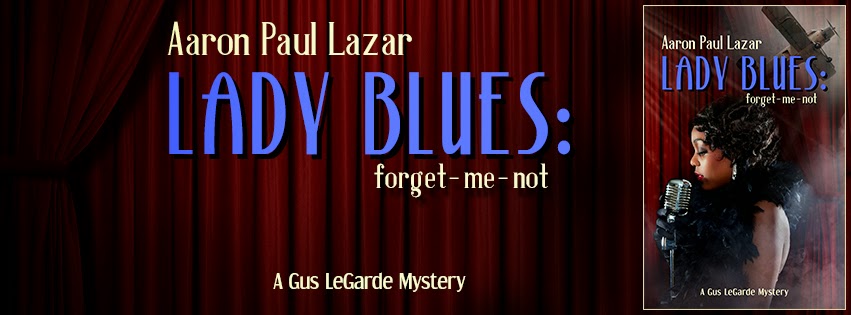
LADY BLUES: forget-me-not  (A Gus LeGarde Mystery)

http://www.amazon.com/Lady-Blues-forget-me-not-LeGarde-Mysteries-ebook/dp/B00IS6EXG0/ref=sr_1_1?s=digital-text&ie=UTF8&qid=1399933186&sr=1-1&keywords=lady+blues
 

SPECIAL DEAL MAY 15th - FREE Kindle eBOOK! 

Music professor Gus LeGarde is just doing a favor for a friend when he agrees to play piano for church services at a local nursing home. He doesn’t expect to be drawn into a new friendship with an elderly Alzheimer’s patient dubbed “the music man” or to stumble across a decades-old mystery locked inside the man’s mind.

Octogenarian Kip Sterling doesn’t know his own name—but he speaks Gus’s language, spouting jazz terms like “cadence” and “interlude” and “riff.” He’s also obsessed with “his Bella,” but nobody knows who she is.

When Kip is given a new drug called Memorphyl, he starts to remember bits and pieces of his life. Gus learns Bella was Kip’s first and only love, but their relationship was shrouded in scandal. Intrigued, Gus agrees to help search for her. Could she still be alive?

Horrified when the miracle drug suddenly stops working and patients begin to backslide, Gus panics. Can he help Kip find his beloved Bella before his newfound memories disappear?

The Seacrest (a love story)

On April 5th-6th, The Seacrest was #1 for all Kindle free downloads in fiction and nonfiction, with over 59,000 downloads! Find out what all the hype is about: 


They say it’s better to have loved and lost than never to have loved at all.

Finn McGraw disagrees.

He was just seventeen when he had a torrid summer affair with the girl who stole his heart—and then inexplicably turned on him. Finn may have moved on with his life, but he’s never forgotten her.

Now, ten years later, he’s got more than his lost love to worry about. A horrific accident turns his life upside down, resurrecting the ghosts of his long-dead family and taking the lives of the few people he has left.

Finn always believed his estranged brother was responsible for the fire that killed their family—but an unexpected inheritance with a mystery attached throws everything he knows into doubt.

And on top of that, the beguiling daughter of his wealthy employer has secrets of her own. But the closer he gets, the harder she pushes him away.

The Seacrest is a story of intrigue and betrayal, of secrets and second chances—and above all, of a love that never dies.

Up Next: Devil's Lake, a standalone romantic thriller


Four years ago, Portia Lamont disappears from a small town in Vermont, devastating her parents and sister, who spend every waking hour searching for her. When she suddenly shows up two years later at their horse farm in a stolen truck with a little mutt on her lap, they want to know what happened.

Was she taken? Or did she run away?

***
That's it for now. I hope to have these books released by end of this year:

Virtuoso
Devil's Lake
Under the Ice
Sanctuary
Murder on the Sacandaga

Wish me luck!

For those of you confused over all these books and series, here's a complete list:


DOUBLE FORTÉ (print, eBook, audio book)
UPSTAGED (print, eBook, audio book)  
MAZURKA (print, eBook, audio book)
FIRESONG (print, eBook, audio book)
DON’T LET THE WIND CATCH YOU (print, eBook, audio book)
VIRTUOSO (COMING IN 2014)
SPIRIT ME AWAY (May 14th 2014)
UNDER THE ICE: COUNTERPOINT (COMING IN 2014)
LADY BLUES (print, eBook, and audio book)

HEALEY'S CAVE (print, eBook, audio book)
FOR KEEPS (print, eBook, audio book)

FOR THE BIRDS (print, eBook, audio book)
ESSENTIALLY YOURS (print, eBook, audio book)
MURDER ON THE SACANDAGA (~2014)

STANDALONES
THE SEACREST (2013)
DEVIL’S LAKE (2014)

WRITING ADVICE: 

WRITE LIKE THE WIND, volumes 1, 2, 3 (ebooks and audio books)

Aaron Paul Lazar writes to soothe his soul. An award-winning, bestselling Kindle author of three addictive mystery series, writing books, and a new love story, Aaron enjoys the Genesee Valley countryside in upstate New York, where his characters embrace life, play with their dogs and grandkids, grow sumptuous gardens, and chase bad guys. Visit his website at http://www.lazarbooks.com and watch for his upcoming SPIRIT ME AWAY (2014), DEVIL’S LAKE(2014), and VIRTUOSO (2014).

Thursday, May 8, 2014

Is this book DOA? Five ways to know

So what do you do when brainstorming is an utter #fail? What happens when the outline does nothing to help you see your way clear to the end of a book that just isn't working?

At what point do you say, I want out of this disastrous book relationship?


Here are a few points to give you a bit of insight:

1. When the book relationship turns sour and you feel like you are hurting yourself when you open the manuscript. When it physically, mentally, and especially emotionally hurts to try to work on the book, it's time to quit.

2. When you have all the time in the world to dive right in but you just can't. It's like dragging a kid to the dentist. Just. Cannot. Do. It.

3. You no longer see the beauty in what you have done thus far. You can no longer say, "When I wrote the first draft, I was in heaven."

4. You find yourself asking the same stupid questions of all of your writer friends, and you already know the answers. "Should I rewrite it?" being chief among them all.

5. You do ugly things to it. You highlight words to change them into other words that mean exactly the same thing.

These things and about ten more are all good reasons to say adios to the book. Some books are not fixable. Some books were never meant to be written and read. Maybe written but not read by anyone but your mother. Maybe not even her. It's OKAY to say no to the book. But it is not okay to say no to your creative drive to write one. There will be other books. You can always tear it up and use bits and pieces in another one. Don't lose sight of the fact that you are a writer, though.

Wednesday, May 7, 2014

Part II of my Interview with Peter Gelfan

Editor Extraordinaire and Author of Found Objects

On the challenges of being an editor, the balance between editing and writing and what matters in writing today.


Peter Gelfan is the kind of editor every writer wants. He has the courage to tell you everything that's wrong with your work while also pointing you in the right direction. He's also a writer, the author of Found Objects, an intriguing new novel about love, loss and acceptance that showcases crisp, powerful writing while challenging our conventional views on love. Finally, Peter is a great teacher. He always asks the right question, but he'll never give you the answer. And that's how you develop good writing, folks.

What's the best part of your job as an editor? The worst?

The best part is reading the next draft of manuscript I’ve edited and seeing that not only did the writer understand the problems I brought up, but also solved them in a creative way that enhanced the rest of the work. The worst is the rare occasion when the next draft isn't much better and the problems remain unsolved and apparently not understood.

How do you balance your job as an editor and your job as a writer? Are your best moments as an editor really different from your best moments as a published author?

I find I have to do one or the other. I can’t write in the mornings and edit in the afternoons. For that matter, I only edit one manuscript at a time. The shift of gears takes up too much time and is frustrating.

The best moments of each are quite different. Writing, the pleasure comes from dreaming up a great idea for the book and making it work well, even better than expected. When editing, to some degree I have to set aside my own creativity as a writer. If I don’t, it’s all too easy to take the client’s idea, run away with it, and start rewriting the manuscript as my own—hey, how about turning your old-man hero into a young woman and setting the novel in modern-day Cleveland rather than Roman Carthage? So I have to always keep in mind what the author wants, and come up with creative ways to deal with whatever stands in his way.

Do you use an editor when you write?

Yes, mostly in the early stages, when I want input on the general idea, characters, and so on.

How did you come up with the idea for Found Objects?

I could give you a raconteur-worthy explanation, but it probably wouldn’t be true. I don’t know where story ideas come from. It’s like falling in love, we have no idea why we fall for this person instead of that one, but after we do, we come up with all sorts of handy reasons, both plausible and not so.

The general question—why do people pair up romantically, sexually, and domestically instead of coming to a more interesting and useful configuration of three or four or more—has knocked around my brain since puberty. But such arrangements rarely last long. How come? Even from close up, or especially so, it’s hard to fathom. The question had prompted a couple of starts earlier that never bore fruit, but then the central premise of Found Objects popped into being and began to grow.

What are the most common issues that you find when editing fantasy?

Some writers become so fascinated by the fantasy world they have thought up that they think it’s their story, and so the novel consists mostly of a guided tour. We get exotic lands, strange creatures, different forms of magic, lots of special effects, intricately designed backstory, but too often little real plot. In fantasy, it’s easy to forget that the world the writer, godlike, has created is, in the universe of the novel, mere setting. In fantasy, setting is often more important than in an earthbound novel, but it’s still just a stage upon which a story of characters in conflict will unfold.

What matters in writing today?

The same as always. Having something to say that could be of value to someone else, and saying it well.
The novel is still evolving, and it’s hard if not impossible to predict where it’s going. But I have a theory, not about where’s it’s headed but why it continues to thrive in whatever form. A novel allows and invites readers to live a life and even its death as if it were their own. Humans may be the only creature that can learn from others’ experiences without directly witnessing them. Stories expand a thousandfold the scope of our innate self-education process of trial and error while avoiding its frequent real-life consequences of injury, death, or wasted years. We absorb those lessons not as dry information but as ersatz experience that, like real life, engages not only the intellect but all our faculties. It’s easy to brush off fiction as entertainment or artsy diversion, but in fact it’s a vital element in our personal and cultural advancement.

Thank you so much for sharing your insights with us, Peter. It's been a pleasure talking to you.

****

Peter Gelfan has been editing and ghostwriting both fiction and nonfiction for the past 20 years. His clients range from beginners to published and bestselling authors and celebrities. He also edits screenplays and has sold two he wrote under his own name, one of which was produced and recently released in France. His novel Found Objects was published in May 2013.

Author contact: gelfanp@gmail.com


****

Dora Machado is the award-winning author of the epic fantasy Stonewiser series and her newest novel, The Curse Giver, available from Twilight Times Books. She grew up in the Dominican Republic, where she developed a fascination for writing and a taste for Merengue. After a lifetime of straddling such compelling but different worlds, fantasy is a natural fit to her stories. She lives in Florida with her indulgent husband and three very opinionated cats.

When she is not writing novels, Dora also writes features for Murder By Four, an award-winning blog for people interested in reading and writing, and Savvy Authors, where writers help writers.